Author: GoCarzSales

  • Private Used Car Sales Melbourne: Step-By-Step Buyer Checklist

    Private Used Car Sales Melbourne: Step-By-Step Buyer Checklist

    Private Used Car Sales Melbourne

    Estimated reading time: 13 minutes

    Key takeaways

    • Private sales can be cheaper but come with fewer consumer protections than licensed dealers.
    • Set a full budget including stamp duty, transfer fees, insurance, and maintenance.
    • Always run a PPSR/regi check, verify the VIN, and cross-check the service history.
    • Inspect in daylight, test drive on mixed roads, and consider an independent inspection.
    • Know your state’s rules and timelines before you pay or transfer ownership.
    • Walk away if details don’t add up—there are plenty of cars in Melbourne.

    Table of contents

    Private sale vs dealer: what’s the difference?

    Thinking about private used car sales in Melbourne? This guide shows you how to buy a second‑hand car, ute, van or truck with confidence. We explain steps, checks, risks, and paperwork so you can shop smarter for used cars in Melbourne. For a deeper overview, see our guide to used car sales and pre‑purchase checks.

    Private sales can offer lower prices because there’s no dealer margin, but consumer protections are limited. Licensed dealers must meet more obligations and often provide warranties and cooling‑off periods, which give you more safety as a buyer. See the NSW Government guide for examples of these protections.

    Be extra careful with private listings where sellers aren’t verified. Scams and odometer tampering are more common in private sales. The NSW Government guide outlines warning signs to watch for.

    “Demo” cars used as showroom demonstrators can be good value, but they are still considered used vehicles and should be checked like any other second‑hand car. See the NSW Government guide for detail.

    For research and model reviews, reputable platforms like CarsGuide can help you compare options.

    Step 1: Set your budget (include all costs)

    Plan for more than just the sale price. Include registration transfer and annual registration, insurance, stamp duty, plus ongoing maintenance and repairs. Our broader used-car guide explains typical on‑road costs.

    The NSW Government’s checklist is also a helpful budgeting prompt: see the NSW Government guide. A simple budgeting tool like the Moneysmart planner can help you set limits. Insurance and maintenance costs can vary a lot by model and age.

    Tip: If you’re considering a work vehicle, be clear on payload, towing needs, and maintenance intervals from the start. This helps you compare a ute, van, or light truck properly. When you’re ready, see our stock: used trucks for sale, used utes, used vans.

    Step 2: Choose where to buy

    You have three main options:

    • Licensed dealership. You’ll usually get consumer protections such as statutory warranties and sometimes a cooling‑off period. See the NSW Government guide for examples.
    • Online platforms. Places like CarsGuide help you browse and compare listings across Melbourne.
    • Private sellers. Often cheaper, but you carry more risk and fewer protections. Be cautious on platforms that don’t verify sellers; scams and odometer issues are more common. See the NSW Government guide for red flags.

    Demo vehicles (ex‑demonstrators) can be sharp buys but are still used cars and should be inspected and checked like any other pre‑owned vehicle. The NSW Government guide explains what to look for.

    Step 3: Research and shortlist

    Start with your needs. Consider city vs country driving, safety features, boot or cargo space, fuel economy, emissions rating, and insurance costs. Use pricing resources to check market value for the model, year, and trim you’re considering. Narrow your list to three to five vehicles that fit your budget and needs.

    For emissions and running‑cost comparisons, the Green Vehicle Guide and emissions ratings are handy tools referenced by consumer experts. If theft risk matters to you, check theft ratings via the National Motor Vehicle Theft Reduction Council.

    Step 4: Run vehicle history and identity checks

    Before you arrange a private inspection, get the VIN (or chassis number) from the seller. Then:

    • Do a rego check and a PPSR (Personal Property Securities Register) search. A PPSR report helps reveal if the car is recorded as stolen or written‑off, and whether there’s finance still owing on it. See official guidance in the NSW Government guide. You can also refer to our quick steps in this buying guide.
    • Cross‑check the details in the ad, the logbook, and the odometer reading. Make sure the numbers line up and service dates make sense.
    • In NSW, free rego checks show the expiry date, registration restrictions, the last three odometer readings, and CTP status. See the NSW Government guide for what a thorough check includes.

    If anything doesn’t add up, walk away. There are plenty of other cars on the market in Melbourne.

    Step 5: Inspect the vehicle in daylight

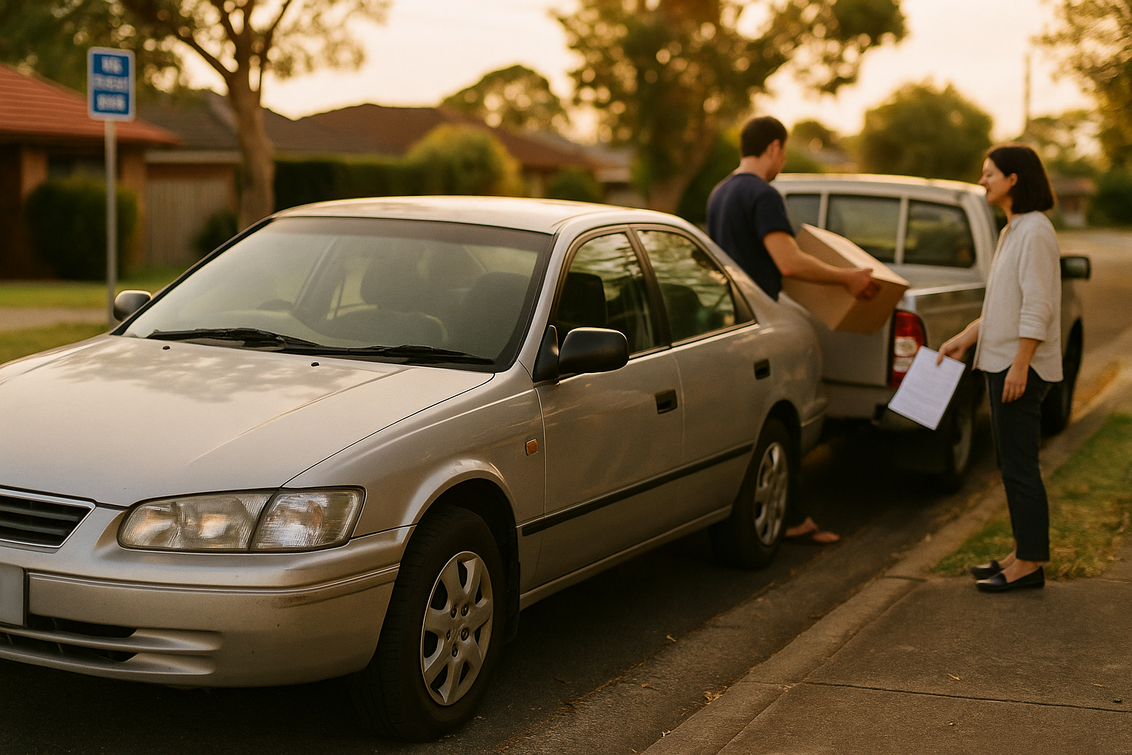
    Book the inspection in full daylight and meet at the seller’s home, not a random car park. Take your time. Better yet, bring a friend for a second set of eyes. For a pre‑inspection prep, see our simple used‑car check tips.

    Use this simple inspection list:

    • Exterior: Look along the body for paint mismatches, overspray, uneven panel gaps, fresh sealant, rust, hail damage, and underbody dents.
    • Tyres and wheels: Check tread depth, wear pattern, and any sidewall damage. Make sure the spare, jack and tools are present.
    • Lights and lenses: Test headlights (low/high beam), indicators, brake lights, reverse lights, fog lights, and the interior light.
    • Glass and mirrors: Check for chips and cracks on the windscreen and windows.
    • Interior: Check seat wear, seatbelts, carpets, headliner, dash warning lights, air‑con, heater, infotainment, reversing camera, and power windows/locks.
    • Under the bonnet: Look for fluid leaks, oil level and condition, coolant level, belts/hoses condition, and any unusual smells.
    • Keys and remotes: Make sure all keys are present and remotes work.
    • Service history: Ask to see the service handbook. Confirm maintenance is up to date and matches manufacturer intervals.

    If you’re not mechanically minded, consider a paid independent inspection—especially for a private sale. A mechanic may spot problems the average buyer misses.

    Tip: Save or print a checklist before you go. vehicle inspection checklist

    Step 6: Take a thorough test drive

    A proper drive tells you much more than an idling engine. On your route, include:

    • Cold start: Listen for rattles, knocks, rough idle, or smoke at start‑up.
    • Urban loop: Test low‑speed steering, brakes, and suspension over speed humps. Listen for interior rattles.
    • Open road: Get to 80–100 km/h, check straight‑line stability and braking. Note engine and tyre noise.
    • Parking: Try tight turns and reverse. Check for steering noises or shudder.

    Assess comfort, visibility, seat support, and whether the vehicle fits your daily needs. Keep the radio off so you can hear everything. Bring a trusted family member or friend to ride along—they may notice issues you miss.

    Step 7: Final checks and negotiation

    Before you hand over any money:

    • Paperwork: Confirm the VIN matches the rego papers and the PPSR report. Review the service history and roadworthy certificate (if supplied).
    • Warranty and cooling‑off: Clarify what you’re getting. Cooling‑off periods and statutory warranties are common at licensed dealers, but not in private sales. See how dealer protections can work in the NSW Government guide.
    • Ask direct questions: Has the car been in any accidents? Any flood or hail damage? Any modifications?
    • Negotiate firmly but fairly: good, well‑maintained cars are still in demand, even if prices have softened in some areas recently.

    If anything feels off, walk away. The right car is out there.

    Rules vary by state. Our overview of interstate differences is here: used‑car sales guide. If you buy in NSW, you must transfer the registration into your name within 14 days or you can be fined; see the NSW Government guide. NSW also provides statutory warranties and cooling‑off periods when you buy from a licensed dealer, but these usually don’t apply to private sales. Take extra care with odometer readings and compare them to service book entries; the NSW Government guide explains the checks.

    For Melbourne buyers, confirm current Victorian requirements (e.g., roadworthy, transfer timelines, duties) with the relevant state authority before you purchase.

    Step 9: Factor in environmental and security considerations

    • Environment and fuel use: Compare fuel economy and emissions using the Green Vehicle Guide and emissions star ratings.
    • Theft risk: Some models attract thieves more than others. Check theft ratings via the National Motor Vehicle Theft Reduction Council.

    Choosing a more efficient and safer model can save money and stress over the long run.

    Step 10: A simple 10‑step plan for private used car sales in Melbourne

    Use this quick checklist to keep the process on track:

    1. Define your needs and budget, including on‑road costs, insurance, and maintenance.
    2. Decide where to buy: dealer, online platform, or private seller (understand the protections and risks). See the NSW Government guide for examples.
    3. Research models, fuel types, and prices; build a shortlist of three to five options.
    4. Arrange a PPSR/rego check using the VIN to rule out stolen/written‑off status or finance owing. Steps outlined in the NSW Government guide.
    5. Inspect the car in daylight and review the service book.
    6. Take a thorough test drive on mixed roads.
    7. Consider an independent mechanical inspection for private sales.
    8. Confirm paperwork (VIN, service history, rego). Clarify warranty and cooling‑off rights before money changes hands.
    9. Negotiate based on condition, history, and market value.
    10. Transfer ownership and complete paperwork promptly as required in your state (for example, NSW has a 14‑day transfer window per the NSW Government guide).

    Practical tips to avoid common traps

    • Meet the seller at their home and check their ID against the registration details.
    • If the price looks too good to be true, it probably is. Compare against market values.
    • Beware freshly detailed engines or underbodies hiding leaks or damage.
    • Watch for mismatched tyres, warning lights, or missing service stamps.
    • If the story changes (e.g., “selling for a friend”), slow down and double‑check everything.

    Private used car sales for work vehicles

    • Match the vehicle to the job: payload, towing, cargo layout, and access (sliding doors for vans, tray length for utes).
    • Estimate running costs: fuel, tyres, servicing, and insurance for that vehicle type.
    • Consider a demo or ex‑fleet vehicle if you want a newer model at a lower price (still a used car; inspect and verify history). See guidance in the NSW Government guide.

    If you later decide that dealer support suits you better, GoCarzSales can help you compare options and finance. finance options

    Conclusion

    Private used car sales in Melbourne can deliver great value if you plan well and do the checks. Set a full budget, shortlist smartly, run a PPSR and rego check, inspect in daylight, test drive thoroughly, and confirm paperwork before paying. Where you buy matters: dealers offer added protections, while private sales require more diligence. Use the steps above to stay safe and confident.

    Ready to find your next vehicle?

    • Explore our range of quality used vehicles today: used trucks for sale, used utes, used vans.
    • Want flexible repayments? Ask about finance options.
    • Have a car to trade? Get a quick trade-in valuation.
    • Prefer a test drive? Book a time and we’ll get you on the road.

    We’re here to help Melbourne buyers find the right car at the right price, with honest advice and a friendly team.

    Important Disclaimer

    This article is general information only. It is not financial, legal, or mechanical advice. Always verify details yourself, including roadworthy, PPSR/rego checks, warranty terms, towing and payload limits, and transfer requirements. Consult qualified professionals or your relevant state authority for advice on your situation.

    FAQs: Private used car sales in Melbourne

    What’s the main difference between a private sale and buying from a dealer?

    Buying from a licensed dealer usually includes consumer protections such as statutory warranties and sometimes a cooling‑off period. Private sales typically don’t include these protections. For examples, see the NSW Government guide.

    What is a PPSR check and why do I need one?

    A PPSR search (using the VIN) helps you see if a vehicle is stolen, written‑off, or has finance owing. It’s a key step when buying privately. See official guidance in the NSW Government guide and our quick buying guide.

    Are demo cars “used” cars?

    Yes. Demo cars are still considered used and should be inspected and checked like any other used vehicle. See the NSW Government guide for tips.

    Is there a cooling‑off period on private sales?

    Cooling‑off periods usually apply at licensed dealerships, not private sales. Always confirm what applies before you pay or sign.

    How can I avoid odometer fraud?

    Cross‑check odometer readings against the service book and any available registration records, and be cautious on platforms that don’t verify sellers. The NSW Government guide lists signs of tampering.

  • Used Car Sales Australia: Step-by-Step Buyer’s Checklist

    Used Car Sales Australia: Step-by-Step Buyer’s Checklist

    Used Car Sales Australia

    Estimated reading time: 11 minutes

    Key takeaways

    • Set a real-world budget that includes on-road and running costs[1].
    • Choose where to buy based on protections vs price (dealer, private, or online)[1][2].
    • Inspect in daylight, test drive thoroughly, and consider a pre-purchase inspection[3][4].
    • Check safety ratings and run all legal checks (PPSR, rego, roadworthy)[1][4].
    • Use a written contract, transfer rego on time, and insure immediately[5][4][1].

    Table of contents

    A quick roadmap

    • Set a real‑world budget that includes on‑road and running costs[1].
    • Decide where to buy: dealer, private seller, or online platform[1][2].
    • Inspect the vehicle in daylight and review its history[3].
    • Check safety ratings and theft risk[1].
    • Do the legal checks (PPSR, rego, roadworthy)[4].
    • Negotiate, close the sale, and transfer the rego properly[4][5].
    • After you buy, insure it, update rego, and plan any maintenance[1][2][5][4].

    Use this article as your step‑by‑step checklist. It’s written for Australian buyers and includes NSW specifics with official links.

    1) Budget first: price, on‑roads, and running costs

    Before looking at cars, set a total budget. Include more than the purchase price. Add insurance, registration, stamp duty, and a buffer for repairs and servicing[1]. Think about fuel use, tyres, and future maintenance.

    Be clear about what you need day to day. A small hatch may suit commuting. A family SUV offers space and safety. A ute or van may be better for work gear or weekend projects[1]. For business use, consider payload, towing, and cargo space.

    Tip: Write your “must‑haves” (safety features, seats, towing) and “nice‑to‑haves” (sunroof, premium audio). This keeps you focused during inspections and test drives.

    2) Where to buy: dealer, private, or online

    There’s no single “best” place. Each option has trade‑offs.

    • Licensed dealers
      • Pros: You may get a statutory warranty and sometimes a cooling‑off period[1][2].
      • Cons: Prices can be higher than private sales[1][2].
    • Private sellers
      • Pros: Often cheaper.
      • Cons: Sales are usually “as is” with fewer protections. There’s typically no cooling‑off period, so do careful checks[1][2]. For more on private sales, especially in Sydney, see the detailed guide on private car sales Sydney for peer-to-peer buying safety and tips[6].
    • Online platforms
      • You can find listings, reviews, and guides on CarsGuide (great for price research and model info) (CarsGuide).
      • Other popular platforms include Carsales and Gumtree[1][2].
      • For buying tips and checklists, see the GoCarzSales Blog (GoCarzSales Blog).

    If you’re weighing up dealer vs private, think about your risk tolerance and how handy you are with inspections. A dealer car might cost more but can include added protections[1][2].

    3) How to inspect a used vehicle like a pro

    Always inspect in full daylight and take a friend for a second opinion[3]. Don’t rush. Use a checklist: vehicle inspection checklist.

    Key things to look for[3]:

    • Walk around the vehicle. Check paint, body gaps, glass, tyres, and signs of repair.
    • Inside, check for water leaks, unusual odours, seat wear, and roof lining condition.
    • Test every button: windows, A/C, lights, indicators, wipers, infotainment, and 12V/USB ports.
    • Review the service book and invoices. Look for regular maintenance and major items being done on schedule.
    • Start the engine cold if you can. Listen for rattles. Check the dash for warning lights.

    Take a proper test drive[3]:

    • Start, idle, accelerate, and brake in a safe area.
    • Feel for vibrations. Note steering pull, brake feel, and gearbox changes.
    • Try low‑speed turns, highway speed, and a hill climb if possible.

    Consider an independent pre‑purchase mechanical inspection, especially for private sales[4]. This small cost can save you from big repairs later[4]. For more advice on pre‑purchase inspections, also see the private car sales Sydney safety guide[6].

    4) Safety and security checks

    • Look up used‑car safety ratings based on real crash data. Safer cars protect both you and your family[1]. When choosing family SUVs or people-movers, check detailed safety features and rear-seat safety[7].
    • Consider theft risk. Review guidance and databases like the National Motor Vehicle Theft Reduction Council[1].

    It’s smart to weigh safety ratings when choosing between similar models. A safer car is often worth paying a little more for peace of mind[1].

    • PPSR check (VIN): Make sure there’s no money owing and it’s not written off or stolen[4]. For more on legal forms and checks, especially in NSW private sales, see our private car sales Sydney guide[6].
    • Registration status: Confirm current rego and plates match the VIN[4].
    • Roadworthy: In many cases you should receive a current roadworthy certificate (state rules vary)[4].
    • Service history and past repairs: Ask for proof. Regular servicing is a good sign[4].

    If anything in the paperwork does not add up, walk away. It’s easier to skip a bad car than to fix a bad decision.

    NSW specifics: transfers, forms, and deadlines

    NSW has clear steps for buying a used vehicle and transferring ownership. You must use the correct transfer of registration form and follow the official process outlined by the state (NSW Government guide). After purchase, lodge the transfer within 14 days to avoid late fees (NSW Government guide).

    If you’re outside NSW, check your state or territory transport site for the right forms and deadlines.

    6) Negotiating and completing the sale

    • Know your numbers. Research similar cars to understand fair pricing.
    • Ask direct questions: Why are you selling? Any finance owing? Any accident damage?
    • Inspect the odometer carefully for signs of tampering[4][5].
    • Be ready to walk away. There are always more cars.

    When you agree on a price:

    • Use a written contract of sale. This is vital for private sales to record details like VIN, price, date, and any promises[4][5].
    • Pay safely. Keep a receipt.
    • Transfer registration in line with your state rules. You’ll likely need to submit forms and pay stamp duty[5][4].

    Keep copies of everything: contract, receipt, PPSR report, roadworthy, rego transfer confirmation.

    7) After you buy: insure, update, and service

    • Insure the car immediately. At minimum, take out third‑party property cover, or go comprehensive for better protection[1].
    • Book any maintenance found in your inspection report[2].
    • Update rego details with your state’s transport authority as required[5].
    • Keep a file with all paperwork for future reference or in case of disputes[4].

    A smooth first month sets you up for years of trouble‑free motoring.

    8) Not ready to commit? Try short‑term options

    If you’re on the fence, renting can help you test models or cover a temporary need. You can rent vehicles like vans for moving or short projects via providers such as Go With The Gecko (Go With The Gecko). For model research and buyer tips before you rent or buy, browse reviews on CarsGuide (CarsGuide).

    Short‑term use can be a smart step before choosing the right second‑hand car or work vehicle.

    9) Common pitfalls and how to avoid them

    • Skipping the PPSR check. You could end up with a car that has money owing or is a statutory write‑off[4].
    • Not getting an independent inspection. Hidden issues can cost thousands later[4].
    • Failing to transfer rego on time. You may face penalties or even be liable for offences after the sale[5].
    • Driving uninsured. Even a short trip home can leave you exposed without cover[1].

    Stick to the checklist in this guide, and you’ll avoid the most expensive mistakes.

    10) Picking the right vehicle type (cars, utes, vans, trucks, minibuses)

    Think about your daily job, family needs, and where you drive.

    • City cars and small SUVs
      • Easy to park, lower fuel use, often cheaper to service.
      • Good for commuting and small families.
    • Family SUVs and people‑movers
      • More seats and boot space.
      • Check safety ratings and rear‑seat features.
    • Utes and cab‑chassis
      • Great for work gear and towing. Confirm payload, tray size, and tow rating suit your needs.
      • Look for genuine service history if used for heavy work used utes. More details on used utes available here[6].
    • Vans and minibuses
      • Useful for trades and group transport. Check cargo length, tie‑downs, and access points.
      • Inspect for signs of heavy commercial use used vans. Learn more about vans and commercial vehicles[6].
    • Light trucks
      • For heavier loads. Verify GVM, towing, and licence class requirements.
      • Pay close attention to maintenance records and tyres used trucks for sale. Explore available trucks and their details[7].

    Fuel type matters too. Diesel can suit long runs and towing; petrol often suits city driving. Match the engine to your usage, not just the badge.

    11) A step‑by‑step buying checklist

    • Budget and needs
      • Set your total budget including on‑roads and a repairs buffer[1].
      • List must‑haves and nice‑to‑haves.
    • Search and shortlist
      • Compare across dealers and private sellers[1][2]. For private sellers, especially in NSW and Sydney, see this detailed private car sales Sydney guide[6].
      • Use reviews and price guides on platforms like CarsGuide (CarsGuide).
    • Inspect and test drive
      • Daylight check with a friend[3].
      • Test all electrics, look for leaks and mismatched paint[3].
      • Review service history and book a pre‑purchase inspection[3][4].
    • Safety and security
      • Check used‑car safety ratings and theft risk guidance[1].
    • Legal checks
      • Run a PPSR check (VIN)[4].
      • Confirm rego and roadworthy, as required in your state[4].
    • Deal and documents
      • Negotiate based on condition and history.
      • Watch for odometer tampering[4][5].
      • Use a written contract, transfer rego, and pay stamp duty as required[5][4].
    • After purchase
      • Insure immediately[1].
      • Update rego details and schedule any repairs[5][2].
      • File all paperwork safely[4].

    Conclusion

    Used Car Sales Australia offers great value if you plan well. Set a realistic budget, choose the right place to buy, and follow a careful inspection and paperwork process. Check safety ratings, run a PPSR, and complete the rego transfer on time. With these steps, you can buy with confidence—whether it’s a city runabout, family SUV, or a hard‑working ute, van, or truck.

    Call to Action

    Ready to find the right second‑hand vehicle? Explore our range of quality used utes, vans, trucks, minibuses and cars. Book a test drive, compare models, and ask our team about flexible options used trucks for sale[7], used utes[6], used vans[6], finance options[6], trade‑in valuation[6].

    Important Disclaimer

    This guide is general information only and is not financial, legal, or mechanical advice. Always verify details such as roadworthy requirements, PPSR results, warranty coverage, and towing/payload limits for your specific vehicle. Consult a qualified mechanic, your insurer, and the relevant state or territory authority before you buy.

    FAQs

    Do I need insurance before I drive it home?

    Yes. Arrange cover immediately, at least third‑party property insurance, or comprehensive for wider protection[1].

    What is a PPSR check and why is it important?

    It’s a national search (by VIN) to see if a car has money owing, is written off, or stolen. It protects you from buying a car with hidden finance or serious history[4]. For details on PPSR in NSW private sales, see the private car sales Sydney guide[6].

    Can I return a used car if I change my mind?

    Private sales are usually final, with no cooling‑off. Dealers may offer a statutory warranty and sometimes a cooling‑off period, depending on the state and terms[1][2]. Always ask before you sign.

    How long do I have to transfer registration in NSW?

    In NSW, buyers have 14 days to lodge the transfer to avoid late fees (NSW Government guide).

    Should I get a mechanic to inspect the car before I buy?

    Yes. An independent pre‑purchase inspection can uncover costly issues that are easy to miss on a quick look[4]. More on this in the private car sales Sydney safety guide[6].

    References

    [1] Choice — https://www.choice.com.au/transport/cars/used/buying-guides/cars

    [2] Roundabout Australia — https://roundaboutaustralia.com.au/newsblog/blog/your-complete-guide-to-buying-a-used-car-in-australia-from-pre-purchase-inspection-to-post-purchase-maintenance/

    [3] RACV — https://www.racv.com.au/royalauto/transport/cars/what-to-know-before-buying-a-used-car.html

    [4] Budget Direct — https://www.budgetdirect.com.au/car-insurance/guides/car-buying/tips-for-buying-a-used-car.html

    [5] Turo — https://turo.com/blog/australia/gearheads/how-to-buy-a-used-car/?p=76

  • Buying Used Cars Sydney: Key Factors and Steps to Consider

    Buying Used Cars Sydney: Key Factors and Steps to Consider

    Buying Used Cars in Sydney: Key Factors and Steps to Consider

    Estimated Reading Time: 6 minutes


    Key Takeaways

    • Approach buying a used car with thorough research and preparation.
    • Inspect the car carefully, including exterior, interior, and under the hood.
    • Use tools like an OBD2 reader and take a test drive to uncover potential issues.
    • Research extensively, including background checks and online forums, before finalizing a purchase.
    • Buying used offers significant cost savings and a wider range of options.


    Table of Contents


    Buying Used Cars in Sydney: Key Factors to Consider

    If you live in Sydney and are considering buying a used car, it’s critical to approach this process armed with the right information. There’s substantial importance in knowing the essential aspects and asking appropriate questions to ensure a successful transaction. Having these prerequisites would not only save you from potential headaches down the line but could also help ensure you get a ride that’s well worth your hard-earned money. Recent advice garnered from a auto experts underscores the importance of these factors when it comes to buying used cars in the city.


    The Upsides of Opting for a Used Car

    When deciding between buying a new or used car, the tangible benefits of the latter are worth noting. The most evident advantage is the price — used cars are generally much more affordable than new ones, allowing you to get more car for your money. Not to mention, there’s a vast range of makes and models to choose from when buying used. Furthermore, with careful research and thorough inspection, you can sidestep future complications and unexpected expenses that often accompany used cars.


    What to Be Vigilant About When Buying Used Cars in Sydney

    Before parting with your cash, it’s crucial to evaluate the car meticulously. Beginning with the exterior, ensure that you examine it in daylight for the most accurate view of its condition. A careful comparison of panels could reveal inconsistencies with their uniformity, acting as warning signs for a history of collisions or rust — the enemies of any used car buyer.

    Another crucial part of exterior inspection you should not gloss over is the car’s tires. Looking out for evenly worn tires could save you from future alignments, tire replacement costs and, most importantly, accidents caused by faulty tires. Unevenly worn tires could mean issues with alignment or suspension, both potentially costly repairs.

    Next up is checking under the hood. Start with the inspection of the transmission fluid, which is typically bright red and has a slight sweet smell when in good condition. A burnt smell or a dark color could indicate a problem with the transmission, likely to cause expensive repairs in the future. Next, you need to scrutinize the engine oil. Its level and color provide valuable information about the car’s engine health. Lastly, don’t forget to check the brake fluid. Its color can reveal the condition of the car’s brakes, with a darker color hinting at possible issues.


    Testing the Waters: Crucial Steps in the Evaluation

    Buying a used car in Sydney? Then it would be wise to keep an Onboard Diagnostic II (OBD2) reader handy. It’s an invaluable gadget that helps you detect car problems that may not be evident from a visual inspection. Simply plug the reader into the car’s OBD2 port (typically found under the dashboard), and it will spit out diagnostic trouble codes and readiness tests showing the car’s overall health.

    In addition to the OBD2 reading, always take the car for a test drive. During the drive, stay as quiet as possible to listen to any unusual noises. From grinding brakes to a stuttering engine, these sounds could suggest potential issues with the car.


    Background Check: Preparing for Purchase

    Just like you wouldn’t hire an employee without thoroughly checking their background, you shouldn’t buy a used car before doing your homework. From online reviews to calling a parts store about common issues with the model you’re considering, gathering as much information as possible helps you make an educated purchase. It’s also a good idea to visit online forums, where you can get unbiased experiences of people who have been using the same model. This not only helps you anticipate potential problems but also gives you a bargaining chip during negotiation.


    By following the above steps and advice, you will be well-equipped to make an informed decision and potentially save thousands on unnecessary repair costs, making buying a used car in Sydney less of a gamble and more of a calculated, successful strategy.


    FAQ

    1. What should I look for when inspecting a used car?

    When inspecting a used car, pay close attention to the exterior condition, tires, and under-the-hood components like transmission fluid, engine oil, and brake fluid. Look for signs of wear, damage, or potential issues that may require expensive repairs.

    2. Why is taking a test drive important?

    A test drive allows you to assess the car’s performance and listen for any unusual sounds that may indicate mechanical problems. It’s a critical step in ensuring the vehicle is in good working condition.

    3. How can an OBD2 reader help when buying a used car?

    An OBD2 reader can reveal diagnostic trouble codes and readiness tests, providing insight into the car’s health that may not be apparent during a visual inspection. It’s a valuable tool to detect hidden issues.

    4. What are the advantages of buying a used car?

    Buying a used car is generally more affordable than purchasing new. It allows you to choose from a wider range of models and can offer significant savings, provided you conduct thorough research and inspections.

    5. How can I research a car’s history before buying?

    You can research a car’s history by checking online reviews, visiting forums for owner experiences, and obtaining a vehicle history report. This information helps you understand potential issues and negotiate better.