Arrow Car Sales
Estimated reading time: 10 minutes
Key takeaways
-
– Set your budget first, then shortlist 3–5 models that fit your needs and price.
– Always run a PPSR check, inspect in daylight, and book an independent pre-purchase inspection.
– Dealers offer added legal protections; private sales can be cheaper but carry more risk.
– Verify service history, rego, roadworthy, and warranty terms before paying.
– Negotiate with facts, use secure payments, and avoid pressure tactics or suspicious links.
Table of contents
- Arrow Car Sales
- Why buy used in Australia
- Your pre-purchase checklist (step by step)
- Where to buy: pros and cons
- Your rights and protections (Australian Consumer Law)
- Essential paperwork for the sale and transfer
- Negotiation and payment tips
- Choosing the right used truck, ute, van, minibus or car
- Practical test-drive checklist you can use today
- Dealer vs private: which is better for you?
- Conclusion
- Call to Action
- Important Disclaimer
- FAQ
Looking up Arrow Car Sales? If you’re comparing used-car options in Australia, this clear guide from GoCarzSales will help you shop with confidence and avoid common traps.
We’ll walk through what to check, where to buy, your rights under Australian Consumer Law, and how to seal the deal safely. You’ll also find simple tips for choosing a used truck, ute, van, minibus or car that fits your needs and budget.
Why buy used in Australia
A used car can save you money and still be reliable. Popular choices with a strong reputation include the Toyota Camry, Toyota Corolla, Mazda CX-5 and Mazda 3. But buying used means you need to look out for hidden faults, any money owing on the car, and scams. A calm, step-by-step approach protects your savings and helps you get the right vehicle the first time.
Your pre-purchase checklist (step by step)
1) Set a clear budget
Think about:
- How long you plan to keep the vehicle.
- Size and features you need.
- How well the model keeps its value.
- Finance options, such as used car loans.
Locking in a budget first keeps you focused and saves time when you inspect and negotiate.
2) Research shortlists (3–5 models)
Match the vehicle to your needs and lifestyle. Make a shortlist of three to five models that fit your budget and space needs. Compare prices and listings on well-known platforms like Carsales, Gumtree and Facebook Marketplace. You can also read motoring reviews on sites such as CarsGuide to help with model research.
Some services connect you to dealer stock nationwide, which can be handy if you need a specific make or model.
3) Check the vehicle history (PPSR)
Use the VIN (or chassis number) to run a PPSR check. This helps confirm the vehicle is not reported stolen, written-off, or still under finance, and it can show if it has been in a serious accident. This step can stop expensive mistakes before you set foot on a lot or meet a seller.
4) Inspect and test drive (in daylight)
See the car in bright daylight and take your time. Look over:
- Paint and panel condition; check for dents or mismatched paint.
- Underbody for leaks or damage.
- Interior wear, seatbelts, dashboard warning lights.
- Tyres (even wear), lights, indicators.
- Features like air con and central locking.
Test the car on different roads and speeds to check engine, brakes, steering and gear shifts. Trust your gut. If something feels off, pause and investigate.
5) Get a professional inspection
An independent pre-purchase inspection can reveal issues you might miss, especially for private sales. This can save thousands by identifying problems before you buy. It’s extra important if you’re a first-time buyer or shopping on a tight budget.
6) Review the paperwork
Before you agree on a price, confirm:
- Full service history and receipts.
- Current roadworthy certificate.
- Registration expiry.
- Owner’s manual and spare keys (if available).
- Any dealer or extended warranties.
This paperwork paints a picture of how the car has been cared for, and what’s covered after you pay.
Where to buy: pros and cons
Licensed dealers
- Pros:
- Statutory protections under Australian Consumer Law. Vehicles must be of acceptable quality, fit for purpose and match the description. If faults appear, remedies can include repair, replacement or refund. In NSW, dealer guarantees apply to certain used cars (for example, vehicles under 10 years old and under 160,000 km) and other buyer protections may include a cooling-off period and help with paperwork and trade-ins (see NSW Government guidance).
- Cons:
- Usually higher prices than private sales.
Buying from a licensed dealer also means you’re protected by law if the car isn’t as described or isn’t fit for purpose (NSW Government overview).
Private sellers
- Pros:
- Often lower prices.
- Cons:
- No dealer warranties or statutory protections; higher risk of scams. You’ll need to do all checks yourself. Use trusted platforms and meet in public places. In NSW, private sales don’t come with the same guarantees, so caution is key (NSW Government advice).
Online marketplaces
- Pros:
- Huge choice with filters to narrow your search.
- Cons:
- Scams can occur if sellers aren’t verified. Stay alert and never click strange links. The NSW Government suggests using trusted websites and avoiding unverified sellers (NSW Government advice).
Auctions
- Pros:
- Possible bargains if you know what you’re doing.
- Cons:
- Higher risk, limited chance to inspect, and typically no warranties.
Your rights and protections (Australian Consumer Law)
When you buy from a licensed dealer, the car must be of acceptable quality, fit for its purpose, and match the description or advertising. If not, you may be entitled to a repair, replacement or refund. In NSW, there are clear guidelines on dealer guarantees for used vehicles under certain age and kilometre thresholds, plus advice on your rights and the added risks of private sales (NSW Government guidance).
Private-sale cars don’t have the same protections, so rely on thorough checks, a proper inspection, a PPSR report, and a careful review of the seller’s paperwork (NSW Government advice).
Essential paperwork for the sale and transfer
Put the key details in writing. A simple sale agreement should include:
- Seller’s full name, address and date of birth.
- Buyer’s full name and address.
- VIN, registration (plate) and engine number.
- Price paid and date of sale.
- Signatures from both sides.
Also gather the service records and any guarantees or warranties that apply. Keeping a tidy paper trail helps with rego transfer and future resale.
Negotiation and payment tips
- Negotiate using facts. Bring your inspection notes, PPSR report and comparable listings. If the seller won’t move on price, ask for extras like extended registration or new tyres.
- Pay safely. Avoid cash, wire transfers or odd payment links. Use secure methods and meet in public places.
- Check listing details. Compare the odometer reading with service records, ask for recent photos, and review seller ratings if available.
- Use trusted sites and be wary of unrealistic prices or pressure tactics. Independent checks help you avoid costly mistakes.
Choosing the right used truck, ute, van, minibus or car
Think about how you’ll use the vehicle week to week. Keep it simple and practical.
- Daily driving: For commuting and school runs, popular reliable choices like the Toyota Camry, Toyota Corolla, Mazda CX-5 and Mazda 3 are worth shortlisting.
- Work and tools: A used ute with a good service history can be a smart, budget-friendly buy. Check the tray, towbar and any accessories for condition and safe operation.
- Payload and towing: Make sure the vehicle’s ratings suit your work or travel needs. Confirm any towing or payload limits in the owner’s manual and with your state authority if unsure.
- Vans and minibuses: For cargo or people movers, inspect sliding doors, seats, air con and interior wear.
- Long trips and touring: Look for comfortable seats, cruise control, and good fuel economy for your trips.
- City vs country: Consider ground clearance, tyre condition and spare-tyre setup if you travel on rough roads.
If you’re a backpacker or first-time buyer on a tight budget, reduce risk by choosing a vehicle with a clear service history and arranging a pre-purchase inspection.
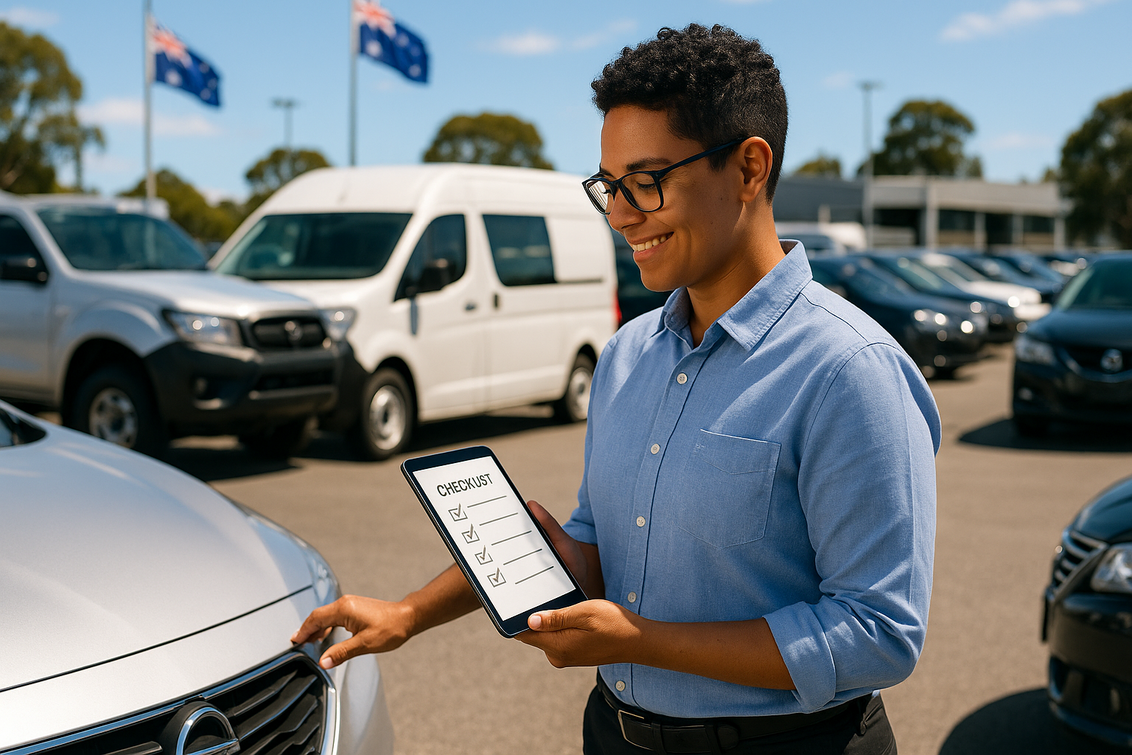
Practical test-drive checklist you can use today
Bring this with you on your phone. If anything doesn’t feel right, pause the deal.
- Before you go:
- Ask for the VIN and run a PPSR check.
- Request photos of service history and the odometer.
- On arrival:
- Inspect panels for dents, overspray or mismatched paint.
- Check tyres for even wear; test all lights and indicators.
- Look under the car for leaks or damage.
- Inside:
- Start the car from cold, listen for odd noises.
- Check warning lights, windows, air con, and central locking.
- On the road:
- Test at city and highway speeds.
- Check straight braking, smooth gear changes, and steady steering.
- After the drive:
- Book a professional inspection if you’re serious about buying.
- Confirm registration expiry, roadworthy certificate, and warranty terms.
For more peace of mind, use trusted platforms, meet in public, and stick to secure payment methods.
Dealer vs private: which is better for you?
- Choose a licensed dealer if you want added protections, help with paperwork, and options like trade-ins. In NSW, there are specific dealer guarantees for certain used vehicles and guidance on cooling-off periods and legal protections (NSW Government guidance).
- Choose a private seller if price is your top priority and you’re confident with checks, inspections and paperwork yourself. Remember, private sales don’t come with the same protections, so be extra careful (NSW Government advice).
If you need a rare model or specific spec, cast a wider net. Some services list dealer stock Australia-wide, which can help match a set budget and feature list.
Conclusion
Whether you started by searching Arrow Car Sales or you’re just beginning your used-car journey, the best buys come from a calm plan: set your budget, verify the car’s history, inspect in daylight, book an independent check, and confirm every document. Know your rights with dealers, and be extra cautious with private sales. When you’re ready, take your shortlist for a test drive and choose the one that feels right.
At GoCarzSales, we stock a wide range of second-hand trucks, vans, utes, minibuses and cars. Explore our range, book a test drive, or ask us about trade-ins and finance. We’re here to help you buy with confidence. used trucks for sale, used utes, used vans, trade-in valuation, finance options, vehicle inspection checklist
Call to Action
Ready to compare models and take the next step? Explore our stock, book a test drive, or request a trade-in valuation with GoCarzSales today.
Important Disclaimer
This article is general information only. It is not financial, legal or mechanical advice. Always verify details yourself (including PPSR, roadworthy, registration, warranty terms, towing and payload limits) and consult a qualified mechanic, your finance adviser, or your relevant state authority before buying.
FAQ
Which used cars are known for reliability?
Models like the Toyota Camry, Toyota Corolla, Mazda CX-5 and Mazda 3 have a strong reputation for reliability and value.
Do I get a warranty with a used car?
From a licensed dealer, you have protections under Australian Consumer Law. In NSW, certain used cars are covered by dealer guarantees with age and kilometre limits, and you may have a cooling-off period. Private sales don’t offer these guarantees.
Is a pre-purchase inspection worth it?
Yes. An independent inspection often finds issues you can’t see and is especially important for private sales or when you’re buying on a tight budget.
What paperwork do I need to transfer ownership?
A written sale agreement with buyer/seller details, VIN, rego, engine number, price, date of sale and signatures. Keep the service history and any warranty information too.
How can I avoid scams when buying a used car?
Use trusted platforms, meet in public, avoid cash or wire transfers, and don’t click strange links. Cross-check the odometer with service records and ask for recent photos.